
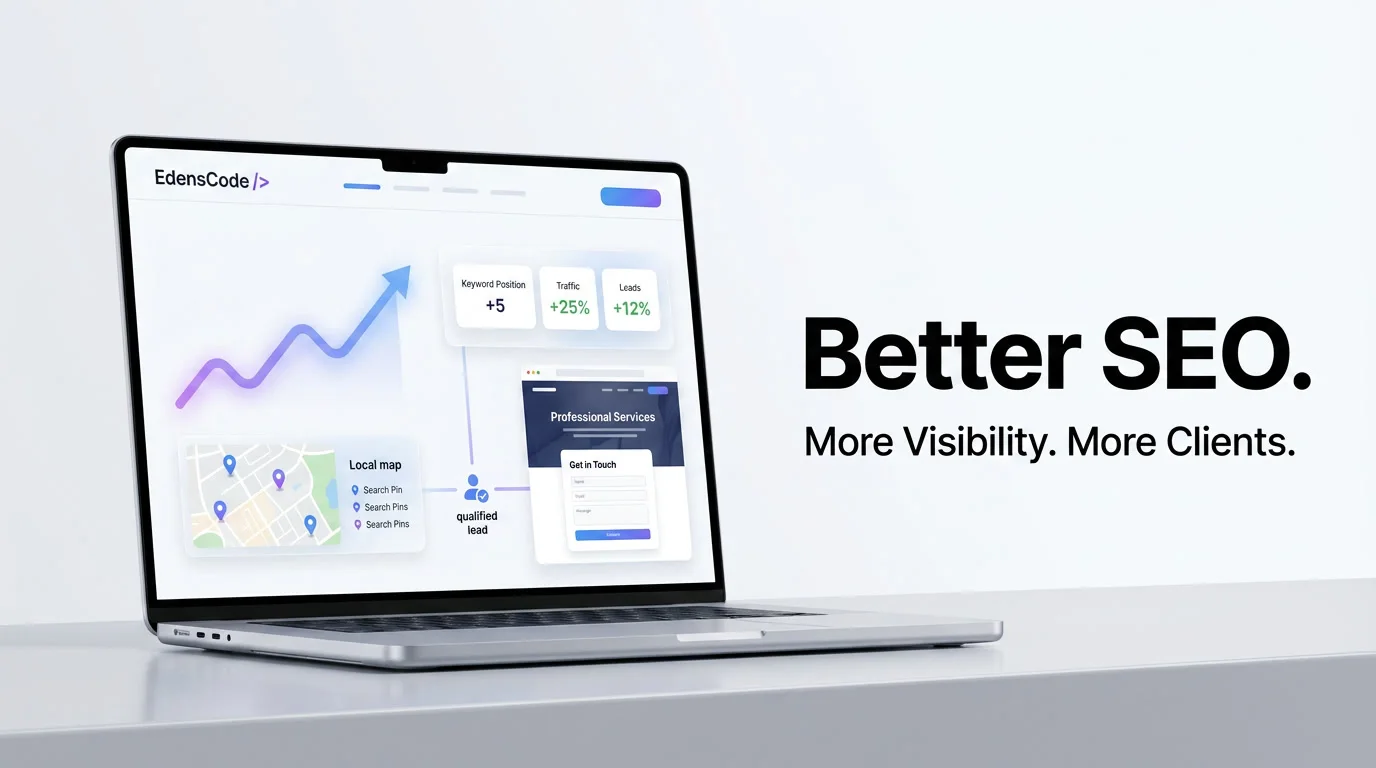
A lot of business owners hear the word SEO and immediately think about rankings.
Getting to the top of Google.
Showing up for keywords.
Getting more traffic.
Beating competitors.
Those things matter, but SEO is not only about rankings.
The real goal of SEO is to help the right people find your business when they are already searching for what you offer.
That is what makes SEO valuable.
Someone looking for a service on Google is usually not just scrolling for fun. They often have a problem, a need, a question, or a decision to make.
They may be looking for a website designer.
They may be comparing local service providers.
They may be searching for pricing.
They may be trying to understand who they can trust.
They may be looking for someone nearby.
They may be ready to call, book, or request a quote.
SEO helps your business show up in those moments.
Not by forcing people to pay attention.
Not by interrupting them.
Not by chasing them around the internet.
But by making your business easier to find when they are already looking.
That is why SEO and search strategy can help a business create more opportunities over time. It is not just about traffic. It is about helping the right people find the right pages at the right moment.
That is why SEO can help you get more clients.
It creates more opportunities for the right people to discover your business, understand what you offer, and take the next step.
But SEO does not work in isolation.
Getting found is only the first part.
Once someone lands on your website, they still need to trust you. They still need to understand your services. They still need to feel confident enough to contact you.
That is why SEO and website design should work together. SEO helps people find you. Website design helps them trust what they find. We explain the design side more in How Better Website Design Helps You Close More Clients.
Quick answer: how does SEO help you get more clients?
SEO helps you get more clients by making your business more visible when people search for the services, questions, and locations connected to what you offer.
A strong SEO strategy can help your business:
- show up for service-based searches
- appear in local search results
- support your Google Business Profile
- answer questions potential clients are already asking
- bring more qualified visitors to your website
- build trust through helpful content
- create more chances for calls, forms, bookings, and quote requests
- stay visible over time without depending only on ads
SEO does not guarantee that every visitor will become a client.
But it can increase the number of people who find your business at the right time.
That matters because more qualified visibility creates more qualified opportunities.
SEO helps people find you when they already need you
One of the biggest advantages of SEO is timing.
With ads, social media, or cold outreach, the business is often trying to get attention.
With SEO, the customer is already searching.
That changes everything.
Someone searching “website designer near me” is in a different mindset than someone casually scrolling Instagram.
Someone searching “how much does a small business website cost” is already thinking about buying or planning.
Someone searching “best web design company for local business” is already comparing options.
Someone searching for a specific service in a specific area is often closer to taking action.
SEO helps your business show up during those searches.
That does not mean every searcher is ready to buy immediately.
Some people are early in the process.
Some are comparing options.
Some are learning.
Some are ready to contact someone now.
A good SEO strategy creates helpful entry points for different stages of that decision.
That could include service pages, location pages, blog articles, pricing guides, FAQs, and helpful explanations.
Each page gives the right person another way to find you.
SEO brings attention without depending only on ads
Paid ads can be useful.
They can help a business get visibility faster, test offers, promote a service, or bring in leads when the business needs attention quickly.
But ads stop when the budget stops.
SEO works differently.
Good SEO builds visibility over time.
A helpful page can keep bringing visitors months or even years after it is published if it stays relevant and useful.
A strong service page can keep supporting local visibility.
A well-structured website can help search engines understand the business more clearly.
A blog article can answer questions people keep searching.
That does not mean SEO is free.
It takes strategy, content, structure, technical work, patience, and ongoing improvement.
But SEO can become one of the strongest long-term assets a business has because it is not only tied to daily ad spend.
It builds equity.
The more useful, clear, and structured the website becomes, the more opportunities the business can create over time.
SEO helps you attract better-fit visitors
More traffic is not always better.
A thousand random visitors who do not need your service are not as valuable as ten visitors who are seriously considering hiring someone like you.
That is why good SEO is not just about getting more clicks.
It is about getting better-fit clicks.
A strong SEO strategy should focus on search intent.
That means understanding what people are actually looking for and what kind of page they expect to find.
For example, someone searching “website design” may be looking for many different things.
- They could want inspiration.
- They could want a definition.
- They could want a tutorial.
- They could want a local website designer.
- They could want pricing.
- They could want to compare platforms.
- They could want to hire someone.
Those are different intents.
A good SEO strategy does not treat every keyword the same.
It builds pages around the searches that matter most for the business.
That is how SEO helps attract people who are more likely to become real clients.
Local SEO helps nearby customers find you
For local businesses, SEO is not just about ranking nationally.
It is about showing up where your customers actually are.
Local SEO helps businesses appear for searches connected to a city, neighborhood, or service area.
That could include searches like:
- web design in Houston
- website designer in West University Place
- SEO services near me
- custom website design for local businesses
- website design in Bellaire
- web designer in River Oaks
For service businesses, local search can be extremely valuable because people often want someone who understands their market, serves their area, or feels close enough to trust.
Local SEO can include:
- Google Business Profile optimization
- service-area pages
- location pages
- local content
- reviews
- local citations
- consistent business information
- internal links
- clear contact details
- schema markup
- service pages with local relevance
The goal is to help both people and search engines understand where the business works and what it offers.
A website that only says “we serve everyone” may be too vague.
A better local SEO foundation makes the business easier to understand by service and location.
SEO supports your Google Business Profile
For many local businesses, Google Business Profile is one of the most important visibility tools.
But the website still matters.
Google Business Profile and the website should support each other.
Your profile can show reviews, photos, services, hours, and location information.
Your website can provide deeper explanations, service pages, FAQs, project examples, pricing context, and stronger trust signals.
When both are aligned, the business feels more complete.
If the Google profile says one thing and the website says very little, that can create a weak impression.
If the website clearly explains the services, service areas, and business details, it supports the local search presence.
The website gives Google and potential customers more context.
That matters because local visibility is not only about having a profile.
It is about having a full online presence that makes the business easier to understand and trust.
SEO helps answer questions before people contact you
People often search before they are ready to talk to someone.
They want answers first.
They may ask:
- How much does this cost?
- How long does it take?
- Is this worth it?
- What should I look for?
- Do I need this service?
- What is the difference between two options?
- What happens after I contact the business?
- How do I know who to trust?
SEO gives your business a chance to answer those questions before the sales conversation begins.
That is powerful.
Helpful content can build trust early.
It can make the business feel knowledgeable.
It can make the visitor feel understood.
It can reduce confusion.
It can help the right person decide whether they are ready.
That does not mean every blog post has to sell aggressively.
In fact, the best SEO content often does the opposite.
It teaches clearly.
It answers honestly.
It helps the reader make a better decision.
When someone feels helped, they are more likely to trust the business behind the answer.
SEO builds trust before the first conversation
Trust does not start when someone fills out a form.
Trust starts earlier.
It starts when they first see your business online.
It starts when they read a page that clearly explains what you do.
It starts when they see helpful answers instead of vague claims.
It starts when the website feels organized, professional, and easy to understand.
SEO can support that trust by making useful content easier to find.
A strong SEO foundation helps your business show up in more moments where people are trying to make decisions.
That could be a service page.
It could be a location page.
It could be a pricing guide.
It could be an article comparing options.
It could be an FAQ.
Each one gives the visitor another reason to feel like your business understands the problem.
That trust can make the first conversation easier.
By the time someone reaches out, they may already understand your approach, your services, and why your business feels different.
SEO works best when the website is strong
SEO can bring people to the website, but the website still has to do its job.
A visitor still needs to feel confident after they land on the page.
If the website looks outdated, loads slowly, feels generic, or makes the next step confusing, SEO may bring traffic without enough results.
That is why traffic alone is not the goal.
The goal is qualified traffic that turns into real opportunities.
A strong website should support SEO by having:
- clear service pages
- helpful content
- strong calls-to-action
- fast performance
- mobile-friendly design
- clear headings
- internal links
- trust signals
- reviews or proof
- easy contact options
- local relevance
- structured information
- FAQs when useful
- analytics and tracking
SEO helps people arrive.
The website helps them move forward.
That is why a strong SEO strategy should not ignore design, messaging, speed, or conversion.
Ranking is not the same as getting clients
Ranking on Google can be valuable, but ranking alone is not the final goal.
The real goal is business growth.
That could mean:
- more calls
- more form submissions
- more bookings
- more consultations
- more quote requests
- more qualified leads
- more people choosing your business over competitors
A page can rank and still fail if visitors do not trust it.
A page can get traffic and still fail if the offer is unclear.
A website can show up and still lose the lead if the design feels weak.
That is why SEO has to be connected to the bigger business goal.
Getting found matters.
But what happens after someone finds you matters just as much.
Good SEO should help create a path from search to trust to action.
SEO gives every important service a better chance to be found
A common mistake is expecting the homepage to rank for everything.
The homepage is important, but it cannot always carry every service, every location, every question, and every type of search intent.
If a business offers multiple services, each important service may need its own page.
For example, a website studio may have pages for:
- custom web design
- SEO and search strategy
- website migrations
- website automation
- website analytics
- website maintenance and support
Each page gives search engines and visitors a clearer understanding of that service.
The same idea applies to many service businesses.
A painter may need separate pages for interior painting, exterior painting, cabinet refinishing, drywall repair, and power washing.
A med spa may need separate pages for facials, injectables, skin treatments, and body treatments.
A law firm may need separate pages for different practice areas.
A repair shop may need separate pages for different devices or repair types.
SEO helps organize the website around how people actually search.
That creates more opportunities to be found for specific services instead of relying on one general homepage to do everything.
SEO helps your content work harder
A business may already have good information, but if it is not structured properly, people may not find it.
SEO helps organize content so it has a purpose.
A blog article should not exist just to fill space.
A service page should not exist just because competitors have one.
A location page should not exist just to repeat the same words with a different city name.
Every page should have a reason.
It should answer a real search intent.
It should support the website structure.
It should help visitors understand the business.
It should connect to related pages.
It should guide people toward the next step.
When content is created with SEO strategy, it works harder.
It can support visibility, trust, internal linking, local relevance, and conversion at the same time.
That is the difference between random content and strategic content.
SEO can reduce dependence on referrals alone
Referrals are valuable.
For many businesses, referrals are the strongest source of trust.
But relying only on referrals can limit growth.
If most clients come from word of mouth, the business may have little control over lead flow.
Some months may be busy.
Other months may be slow.
SEO can help create another channel.
It does not replace referrals.
It supports them.
A referred customer may still search your name and visit your website before reaching out.
A person who finds you through Google may later read reviews, look at your site, and feel like they got a referral-level impression because the website answered their questions clearly.
SEO helps people discover the business even if nobody personally recommended it yet.
That can make growth more consistent over time.
SEO can support higher-quality leads
Good SEO is not about attracting everyone.
It is about attracting the right people.
That matters for businesses that do not want every possible lead.
Some businesses want higher-quality clients.
Some want people with the right budget.
Some want clients who value quality.
Some want fewer but better projects.
SEO can help with that by shaping the way the business is presented.
For example, the website can explain:
- who the service is best for
- what kind of problems the business solves
- what makes the approach different
- what the process looks like
- what level of quality someone should expect
- what price range or investment level makes sense
- what is included
- what is not a good fit
This helps filter visitors.
The wrong people may leave.
The right people may feel more confident.
That is not a bad thing.
A good website should not only get more leads.
It should help attract better-fit leads.
SEO takes time, but that is part of the value
SEO is not instant.
That can frustrate business owners who want fast results.
But the time it takes is also part of what makes SEO valuable.
Ads can create visibility quickly, but they require ongoing spend.
SEO builds over time through better pages, better content, better structure, stronger local signals, better authority, and better trust.
The results can take months, especially in competitive markets.
But the work can keep supporting the business long after the page is published.
That is why SEO should be seen as a long-term growth channel, not a quick trick.
A serious SEO strategy is built with patience.
It requires tracking, testing, improving, and adding the right pages over time.
That is how a website becomes stronger.
Not all at once.
But piece by piece.
SEO is not just keywords
A lot of people still think SEO means adding keywords to a page.
Keywords matter, but they are only one part of SEO.
A stronger SEO strategy includes:
- page structure
- service page planning
- local search strategy
- technical SEO
- metadata
- heading structure
- internal linking
- schema markup
- performance
- mobile usability
- content quality
- search intent
- Google Business Profile alignment
- analytics
- conversion tracking
- ongoing improvements
SEO is not just what words appear on the page.
It is how the website is structured, how helpful the content is, how clear the business is, and how easy the website is for people and search engines to understand.
That is also why we wrote Website or SEO: Which One Does Your Business Need First?. SEO works best when it is connected to the website foundation, not treated like something added after the site is already finished.
The best SEO feels helpful, not spammy
Good SEO should not make a website feel awkward.
It should not force the same keyword into every sentence.
It should not turn a service page into a wall of text.
It should not create copied city pages with only the location name changed.
It should not sound like content written only for search engines.
The best SEO feels natural because it is built around real questions, real services, and real decisions.
It helps the visitor.
It explains the business clearly.
It gives search engines enough structure to understand the page.
It supports trust instead of weakening it.
That matters because SEO is not just about getting someone to land on a page.
It is about helping them feel like they landed in the right place.
SEO and website design work better together
SEO helps people find the business.
Website design helps people trust the business.
Copywriting helps people understand the business.
Performance helps people feel confident using the website.
Analytics helps the business understand what is working.
Conversion strategy helps turn attention into action.
All of these pieces connect.
A website that is beautiful but invisible has a visibility problem.
A website that ranks but does not convert has a trust or experience problem.
A website that has traffic but no tracking has a measurement problem.
A website that gets clicks but no leads may have a message, design, offer, or conversion problem.
SEO is powerful, but it is strongest when the full website supports it.
That is why the best approach is not SEO alone.
It is a website foundation built for search, trust, and action.
The EdensCode perspective
At EdensCode, we see SEO as part of the website foundation, not something that gets sprinkled on later.
A business website should be built so people can find it, understand it, trust it, and take the next step.
That means SEO should work with design, content, performance, analytics, and conversion strategy.
The goal is not just to rank.
The goal is to create more real opportunities for the business.
That means building clear service pages.
It means creating useful content.
It means strengthening local signals.
It means improving speed and structure.
It means helping search engines understand the business.
It also means making sure visitors feel confident once they arrive.
Because SEO can bring attention.
But the website has to turn that attention into trust.
And trust is what creates more clients.
Final answer: how does SEO help you get more clients?
SEO helps you get more clients by making your business easier to find when people are already searching for what you offer.
It helps your website show up for services, questions, locations, and buying decisions connected to your business.
It can bring more qualified visitors to your website.
It can support your local search presence.
It can build trust through helpful content.
It can create more opportunities for calls, forms, bookings, consultations, and quote requests.
But SEO is not magic.
It works best when the website is clear, professional, fast, trustworthy, and built to convert.
SEO helps people find you.
A strong website helps them choose you.
When both work together, your business has a stronger path from search visibility to real client opportunities.
Frequently asked questions
How does SEO help a business get more clients?
SEO helps a business get more clients by making it easier to find when people search for services, questions, and locations connected to what the business offers. It creates more opportunities for qualified visitors to discover the business and take action.
Does SEO guarantee more clients?
No. SEO does not guarantee that every visitor will become a client. It can increase qualified visibility, but the website, offer, reviews, trust, pricing, and conversion flow still affect whether someone contacts the business.
Is SEO only about getting more traffic?
No. Good SEO is not just about traffic. It is about attracting better-fit visitors who are searching for the services, answers, or locations connected to your business.
How long does SEO take to bring clients?
SEO usually takes time, especially in competitive markets. Some improvements can help sooner, but long-term SEO often builds over months through better pages, better content, stronger structure, local signals, and ongoing improvements.
Why does SEO need a strong website?
SEO can bring people to a website, but the website still needs to build trust and make the next step clear. If the website feels outdated, slow, confusing, or generic, traffic may not turn into real leads.
Can local SEO help service businesses get more clients?
Yes. Local SEO can help service businesses show up for searches connected to their city, neighborhood, service area, or nearby customers. This is especially useful when people want a business that feels local and trustworthy.
Should SEO and website design be planned together?
Yes. SEO and website design work best when they are planned together. SEO helps people find the website, while design, content, performance, and conversion strategy help visitors trust the business and take action.