
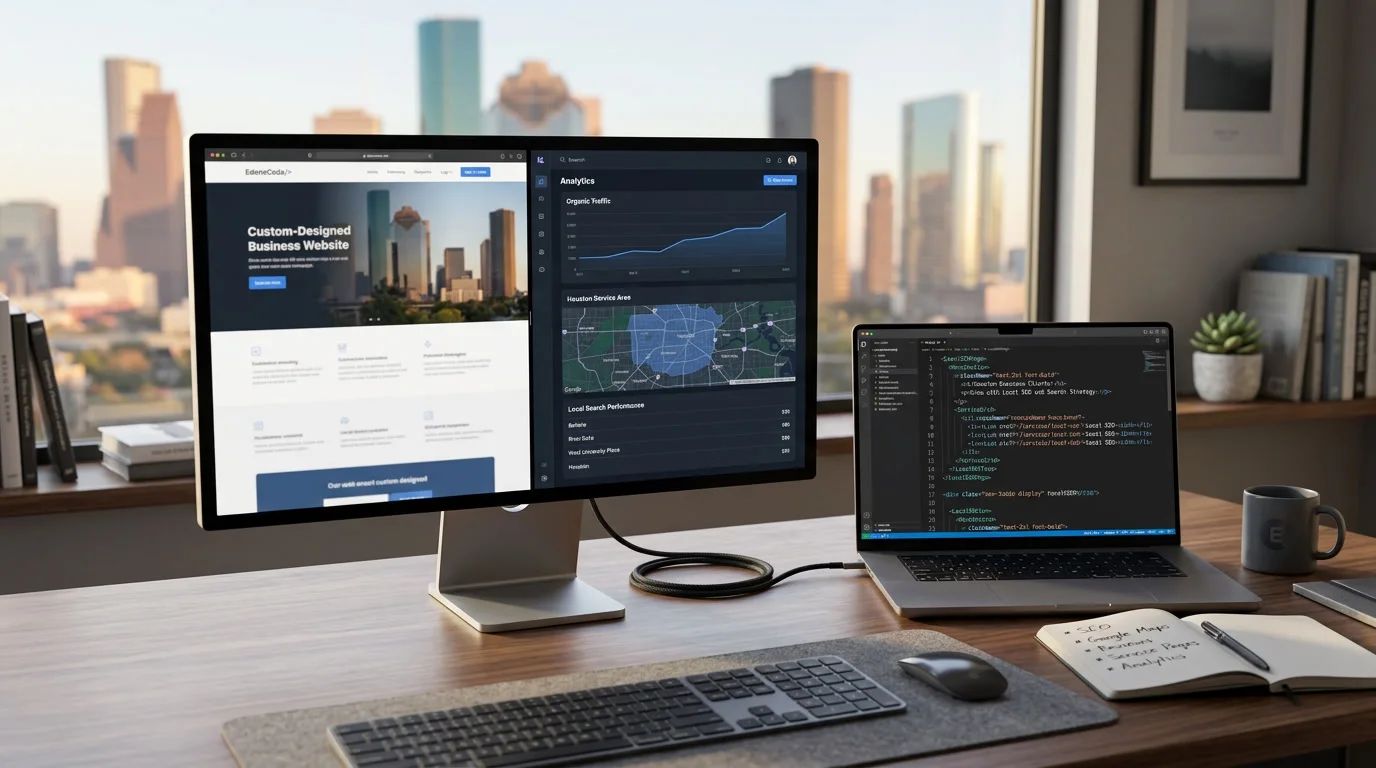
You can have a great business and still be hard to find online.
That happens more often than people realize.
A business can have great reviews, years of experience, loyal customers, and strong word of mouth, but still barely show up when someone nearby searches for the service.
When that happens, potential customers may never know the business exists.
They search Google.
They look at the map results.
They compare a few businesses.
They visit a few websites.
And usually, they contact one of the businesses they found first.
That is where local SEO matters.
Local SEO helps make your business easier to find when people nearby are already searching for what you offer.
For a Houston business, that might mean showing up when someone searches for a service in Houston, Bellaire, River Oaks, West University Place, or another nearby area you serve.
The goal is simple.
Help nearby customers find the business.
Help them understand what it offers.
Help them trust it.
And make it easy for them to call, book, request a quote, or take the next step.
That is also why SEO and search strategy should connect the website, local search presence, service pages, and location signals instead of treating each one like a separate piece.
Quick answer: what is local SEO?
Local SEO is the process of helping nearby customers find your business through Google Search, Google Maps, and other local search results.
In plain English, it means making it easier for people in your area to find you when they search for the service you provide.
For example, someone may search:
- electrician near me
- website designer in Houston
- house painter in Bellaire
- law firm in River Oaks
- med spa near me
- plumber in West University Place
Local SEO helps Google understand what your business does, where it operates, and which searches it may be relevant for.
It also helps potential customers understand the same thing.
That is the part people sometimes miss.
Local SEO is not only about Google.
It is also about making the business clearer for the people searching.
Why local search matters so much for service businesses
Most local service businesses do not need customers from everywhere.
They need customers from the areas they actually serve.
A contractor in Houston does not need random website traffic from another state.
A salon does not need thousands of visitors who live hours away.
A repair shop does not benefit much from ranking nationally if most customers need to visit the store.
What matters is visibility where the customers are.
That is why local SEO can be so valuable.
It focuses on the searches that are more likely to turn into real calls, visits, bookings, and quote requests.
Someone searching for a service nearby is often closer to taking action than someone reading a broad article about the topic.
They already know they need something.
Now they are deciding who to contact.
Local SEO helps you show up when customers are already looking
One of the biggest advantages of local SEO is timing.
You are not trying to convince someone that they need a service they never thought about.
They are already searching.
They may search for the service.
They may search for the service plus a city.
They may search for the service plus a neighborhood.
They may search using “near me.”
They may search for the best option nearby.
Those searches can be extremely valuable because the customer already has intent.
Local SEO helps put the business in front of them during that decision.
Google Maps can be just as important as the regular search results
When people think about SEO, they often imagine the normal Google results.
But for local businesses, Google Maps can be just as important.
A local search may show a map with nearby businesses before someone even reaches the normal website results.
That means your Google Business Profile can become one of the first things a potential customer sees.
They may see:
- your business name
- your reviews
- your rating
- your photos
- your hours
- your phone number
- your website
- your services
- your location or service area
That is a lot of information before they even visit the website.
This is why the Google Business Profile should not be treated like a small side listing.
For many local businesses, it is one of the most important parts of the online presence.
Your website and Google Business Profile should support each other
A Google Business Profile can help someone discover the business.
The website gives them the deeper information they need before choosing it.
The profile may show the basic facts.
The website can explain:
- what each service includes
- who the service is for
- where the business works
- what makes the business different
- what customers can expect
- reviews and proof
- pricing context
- frequently asked questions
- how to contact the business
When the website and Google Business Profile tell the same clear story, the business feels stronger.
When one looks complete and the other feels outdated or vague, it can create doubt.
Local SEO works best when the full online presence supports the same business information.
Service-area pages can help Google understand where you work
This is where service-area pages can become useful.
If your business genuinely serves multiple areas, it can make sense to create helpful pages for those locations.
For example, a Houston-based business may serve:
- West University Place
- Bellaire
- River Oaks
- Montrose
- The Heights
- Memorial
- Sugar Land
- Katy
A useful service-area page can explain what the business offers in that area, who it helps, and why someone nearby may want to work with the business.
The important word is useful.
A service-area page should not be the same page copied eight times with only the city name changed.
That does not help the visitor very much.
A better location page should feel relevant to the area.
It should have its own purpose.
It should connect naturally to the services the business actually offers.
You can see how we structure this on the EdensCode service areas page, where individual locations connect back to the same core website design and SEO services.
Do you need a page for every city you serve?
No.
More pages are not automatically better.
A business should create service-area pages when the locations actually matter.
That usually means the business serves the area, wants customers from the area, and can create a page that gives visitors something useful.
You do not need fifty city pages just because you are willing to drive there.
That can quickly turn into thin, repetitive content.
A better approach is to focus on the areas that matter most.
Build strong pages for those locations.
Then expand carefully if there is a real reason to do it.
A service-area page should do more than repeat a city name
A weak location page may say the city name over and over without giving the visitor much useful information.
That is not the goal.
A better service-area page can include:
- a clear explanation of the service
- the area being served
- the types of businesses or customers you help there
- relevant trust signals
- real service information
- FAQs
- project examples when available
- reviews
- links to core service pages
- clear contact options
The page should still make sense if a real customer lands on it.
That is a good rule for almost every SEO page.
If the page only exists for Google and would feel strange to a customer, it probably needs more work.
Reviews help local customers trust you faster
Reviews are one of the strongest trust signals a local business has.
Before people contact a business, they often check what other customers have said.
A strong review profile can make the decision easier.
People may look at:
- the overall rating
- how many reviews the business has
- how recent the reviews are
- what customers mention
- how the business responds
- whether the reviews feel real
Reviews do more than make a business look popular.
They answer the question every new customer has:
Can I trust this business?
The website should support those reviews by giving people more proof once they click through.
Consistent business information matters
Local SEO becomes harder when the internet has conflicting information about the business.
For example, one website may show an old phone number.
Another listing may show the old business name.
A directory may show outdated hours.
The website may show a different address than the Google Business Profile.
That creates confusion.
For people, it makes the business feel less dependable.
For search engines, it can make the business harder to understand.
That is why basic business information should stay consistent across the places customers may find you.
That includes the business name, phone number, website, hours, services, and location details.
Your main service pages still matter
Service-area pages are useful, but they should not replace the main service pages.
The service page explains what you do.
The location page explains where you do it.
Those are different jobs.
For example, a business may have a main page about custom web design and separate pages for website design in Bellaire or website design in River Oaks.
The main service page should still be the strongest explanation of the service itself.
That is why our Custom Web Design page explains the service in depth, while the service-area pages connect that service to the local markets we serve.
Internal links help customers and Google understand the website
A good local SEO website should not feel like a collection of disconnected pages.
The pages should connect naturally.
A location page may link to the main service page.
A service page may link to the service-area hub.
A blog article may link to a related service.
A city page may link to another useful article.
These links help visitors continue learning instead of hitting a dead end.
They also help search engines understand how the website is organized.
That is why internal linking is part of a strong SEO foundation.
A fast website still matters for local SEO
Getting someone to find the website is only the first step.
If the page loads slowly or feels frustrating on mobile, the visitor may leave before contacting the business.
That is especially important with local searches because many of them happen on phones.
Someone may be sitting in a parking lot.
They may be comparing businesses between appointments.
They may need a service quickly.
They are probably not going to wait around for a slow, broken, or confusing website.
A strong local website should feel fast, clear, and easy to use.
Local SEO is not just adding city names to the website
This is one of the biggest misunderstandings about local SEO.
Adding Houston fifty times to a page is not a local SEO strategy.
Adding a list of twenty cities to the footer is not a complete local SEO strategy.
Creating copied pages for every suburb is not a complete local SEO strategy.
Local SEO works better when the full picture makes sense.
That includes:
- a clear website
- strong service pages
- useful location pages
- Google Business Profile
- reviews
- accurate business information
- internal links
- good mobile performance
- helpful content
- local trust signals
The goal is not to make the website look optimized.
The goal is to make the business easier to find and easier to understand.
Local SEO can help businesses compete beyond their immediate street
A local business may physically sit in one part of Houston but serve customers across several nearby communities.
Without the right website structure, Google may only have a limited understanding of that service area.
That can make it harder for the business to show up outside its immediate location.
Strong local SEO helps communicate where the business actually works.
This is especially important for service-area businesses that travel to customers instead of relying only on walk-in traffic.
A painter, contractor, mover, designer, attorney, consultant, repair company, or home service provider may serve multiple areas from one office.
The website should make that clear without looking spammy.
Local content can help answer real customer questions
Not every local SEO page has to be a service-area page.
Helpful blog content can also support local visibility.
A business can write about questions customers in its market actually ask.
That might include:
- pricing questions
- service comparisons
- what to expect before hiring someone
- common local problems
- how to choose the right provider
- whether a certain service is worth it
- what affects cost in the local market
This kind of content can help a business become useful before the customer is ready to call.
That builds trust.
And when the visitor eventually needs the service, the business may already feel familiar.
Local SEO and website design work better together
Local SEO helps people find the business.
Website design helps them trust what they find.
Those two things should work together.
A business can rank well and still lose the lead if the website feels outdated or confusing.
A business can have a beautiful website and still struggle if nearby customers never find it.
The strongest local website does both.
It helps the business become easier to find.
Then it helps the visitor feel confident enough to take action.
We explain the conversion side of that more in How Better Website Design Helps You Close More Clients.
Local SEO does not happen overnight
Local SEO takes time.
A new location page may not rank immediately.
A new Google Business Profile may take time to build visibility.
A business may move up and down while Google tests different results.
Competitive areas may take longer than less competitive ones.
That is normal.
Local SEO works better when it is treated as a long-term business asset instead of a quick trick.
The website gets stronger.
The business earns more reviews.
The local pages gain history.
The brand becomes easier to understand.
More useful content gets added.
Over time, those pieces can work together.
Common local SEO mistakes
Local SEO can go wrong when businesses focus too much on shortcuts.
Some common mistakes include:
- creating dozens of copied city pages
- stuffing city names into every paragraph
- ignoring Google Business Profile
- using outdated phone numbers or addresses
- buying fake reviews
- having no real service pages
- using a slow or difficult website
- creating pages with no useful information
- ignoring internal links
- expecting rankings immediately
Most of these mistakes come from thinking about local SEO as a trick instead of a system.
The best local SEO usually looks simple from the outside.
The business information is clear.
The website makes sense.
The services are easy to find.
The service areas are clear.
The reviews are real.
The website is useful.
That simplicity is often the result of good structure underneath.
Local SEO can help you rely less on referrals alone
Referrals are great.
But they are hard to control.
A business may have a strong month because several customers recommended it.
Then the next month may be quiet.
Local SEO gives the business another way to be discovered.
People who have never heard the business name before can still find it through search.
Then the website, reviews, and local presence can build the trust that a referral normally creates.
That does not replace word of mouth.
It gives the business another channel.
The EdensCode perspective
At EdensCode, we see local SEO as part of the website foundation.
It should not feel separate from the website.
The service pages, location pages, Google Business Profile, reviews, website structure, and internal links should support each other.
The goal is not to create pages just because Google might rank them.
The goal is to create useful pages that help people understand the business and help search engines understand it too.
For Houston businesses, that means being clear about the services you offer and the areas you actually serve.
It means building trust before someone contacts you.
It means making the website easy to use.
It means making the next step obvious.
And it means building local visibility over time instead of depending on shortcuts.
In plain English
Local SEO simply means helping nearby customers find your business when they are already searching for what you do.
If someone in your area needs your service, your business should have a fair chance to appear.
Your Google Business Profile helps them discover you.
Your service and location pages help them understand you.
Your reviews help them trust you.
Your website helps them decide whether to contact you.
That is local SEO.
Final answer: how does local SEO help Houston businesses get more clients?
Local SEO helps Houston businesses get more clients by making them easier to find when nearby customers search for their services.
It can improve visibility in Google Search and Google Maps.
It can help Google understand the areas the business serves.
It can connect service pages with helpful location pages.
It can support the Google Business Profile.
It can build trust through reviews, useful content, and a stronger website.
And it can create more opportunities for nearby customers to call, book, visit, or request a quote.
The goal is not simply to rank for a city name.
The goal is to make the business easier to find, easier to understand, and easier to choose.
Frequently asked questions
What is local SEO?
Local SEO helps a business become easier to find when nearby customers search for its services through Google Search, Google Maps, and other local search results.
Can local SEO help a Houston business get more clients?
Yes. Local SEO can help Houston businesses reach people who are already searching for their services in Houston and nearby communities, creating more opportunities for calls, bookings, visits, and quote requests.
Do service-area pages help local SEO?
They can. Service-area pages can help explain where a business works and give customers useful information about services available in their area. They work best when each page is genuinely useful instead of being copied with only the city name changed.
Do I need a page for every city I serve?
No. A business should usually focus on the locations that matter most and where it can create genuinely useful content. Creating dozens of thin or repetitive city pages is not automatically better.
Does Google Business Profile help local SEO?
Yes. Google Business Profile is an important part of local visibility because it can appear in Google Maps and local search results. It works best when the business information, services, reviews, and website all support each other.
How long does local SEO take?
Local SEO usually takes time. Some changes can help relatively quickly, but stronger local visibility often builds over months through better website structure, reviews, service pages, location pages, Google Business Profile activity, and ongoing improvements.
Is local SEO just adding city names to a website?
No. Local SEO includes the full local presence: service pages, location pages, Google Business Profile, reviews, accurate business information, internal links, website quality, helpful content, and clear local signals.
What is more important for local SEO, the website or Google Business Profile?
Both matter. Google Business Profile can help people discover the business in local search and Maps, while the website gives customers deeper information about services, trust, service areas, and how to take the next step.