
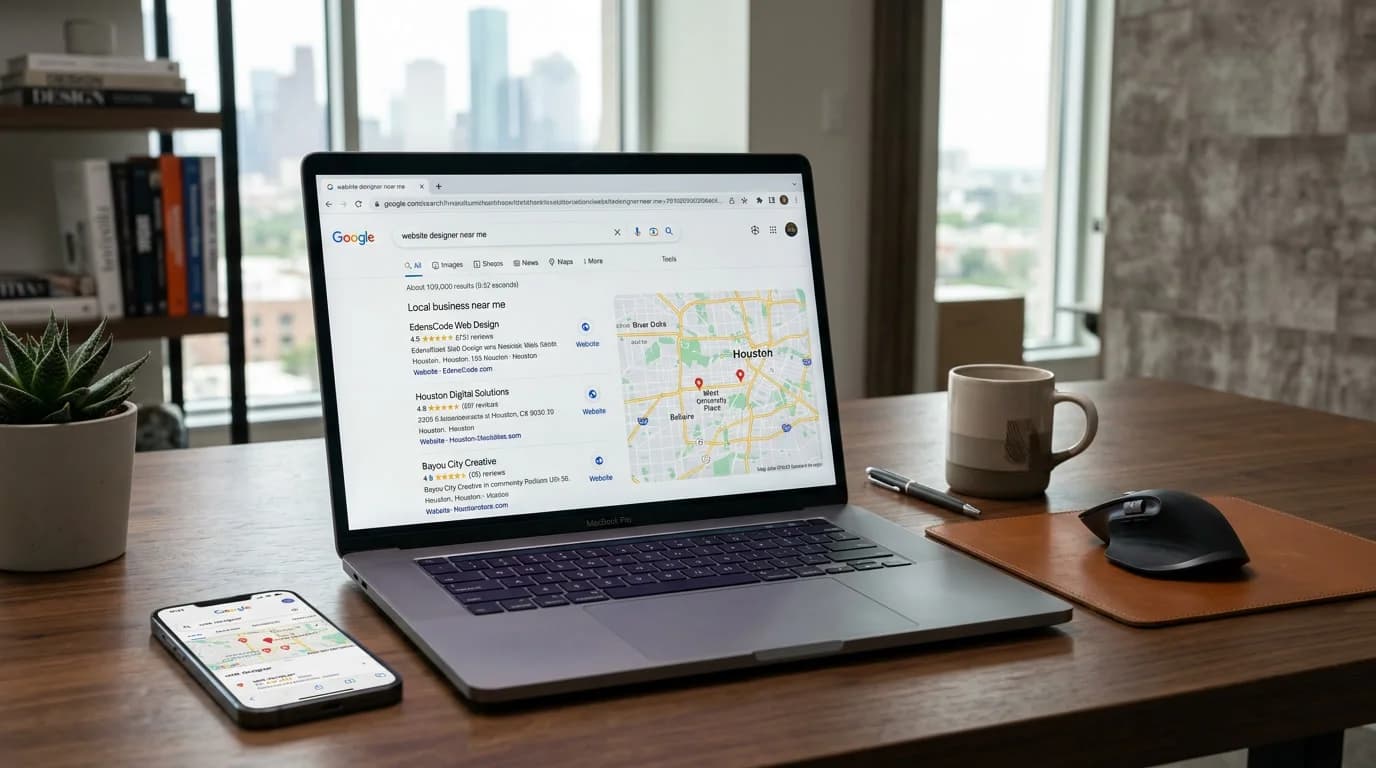
When people need a local business, one of the first things many of them do is search Google.
They might need an electrician.
A dentist.
A moving company.
A website designer.
A repair shop.
Or almost any other service available nearby.
But customers do not all search the same way.
One person might search for the service and their city.
Another might search “near me.”
Someone else might open Google Maps and compare businesses.
Another person might already know your business name and search for you directly after hearing about you from a friend.
All of those searches can lead someone to your business.
That is why being visible locally is bigger than simply having a website or creating a Google Business Profile.
Google is trying to understand what your business does, where it operates, how relevant it is to the search, and whether it appears to be a useful result for the person looking.
That is where SEO and search strategy come in. A strong local presence gives Google and potential customers clearer information about your services, your business, and the areas you serve.
Quick answer: how do customers find local businesses on Google?
Customers can find local businesses through Google Search, Google Maps, local search results, Google Business Profiles, business websites, service pages, location pages, reviews, and searches connected to a specific city or area.
For example, someone looking for a local service might search:
- electrician near me
- moving company in Houston
- dentist in Bellaire
- website designer in Katy
- roof repair near me
- best plumber nearby
- web design in River Oaks
Google then tries to return businesses that make sense for that particular search.
Where a business appears can depend on several factors, including relevance, distance, prominence, the information Google understands about the business, and the strength of its overall online presence.
Customers search for the service they need
Most customers do not begin by thinking about SEO.
They begin with a problem.
Their air conditioner stopped working.
They need their house painted.
Their business needs a new website.
They need a lawyer.
They need someone to repair a device.
So they describe what they need to Google.
This is important because your business needs to be clearly connected to the services you actually provide.
If your website barely explains those services, Google has less information to work with and customers have less information to evaluate.
A business that clearly explains each important service creates more opportunities to match the searches potential customers are making.
Customers often add a location to their search
Local searches often include a geographic area.
That could be a city.
A neighborhood.
A suburb.
Or simply the words “near me.”
Someone in the Houston area might search for a service in Houston, Katy, Cypress, Bellaire, Sugar Land, The Woodlands, or the particular neighborhood where they live or work.
These searches tell Google that location matters to the person searching.
For a local business, that means Google needs to understand not only what the business does but also where the business operates.
A clear service-area structure can help explain where a business works while giving potential customers useful information about service availability in their area.
What happens when someone searches “near me”?
A customer does not have to type their city every time.
Searches such as “electrician near me,” “website designer near me,” or “moving company near me” tell Google that the search has local intent.
Google can use the searcher's location along with information it has about nearby and relevant businesses to decide which results to show.
This is one reason proximity can matter in local search.
But being the closest business does not automatically mean you will always be the first result.
Google also considers how relevant a business appears to the search and how prominent or established it appears.
That means a strong local presence still matters even when the customer never types the name of their city.
Google Maps is another way customers discover businesses
Some customers never make it very far down the traditional search results.
They see the local map results and begin comparing businesses there.
Others go directly to Google Maps and search.
This is especially common when someone wants a business nearby.
A customer can quickly compare information such as:
- business name
- reviews
- rating
- photos
- hours
- services
- location
- website
- phone number
- directions
This can happen before the customer ever visits your website.
That makes your presence on Google an important part of your first impression.
Your Google Business Profile helps customers understand your business
For local businesses, Google Business Profile can be one of the most visible parts of the search experience.
It can help customers understand what the business does before they click anywhere else.
A complete profile can provide useful information about services, hours, photos, reviews, contact information, and other business details.
But creating a profile does not mean the rest of your online presence stops mattering.
Your profile and your website should tell the same story.
If your profile says you provide a service but your website barely mentions it, the experience can feel incomplete.
If your website clearly explains the service, shows your work, answers questions, and makes contacting you easy, the customer has much more information to use when making a decision.
Your website helps customers decide whether to trust you
Getting found is only the beginning.
Once someone discovers your business, they usually start evaluating it.
They may visit your website.
They may read reviews.
They may look at photos.
They may compare you with two or three competitors.
They may look for pricing information or examples of your work.
They may simply ask themselves whether the business looks legitimate and professional.
This is where the website becomes more than something that exists because every business is supposed to have one.
It becomes part of the decision.
A strong custom business website can explain the services clearly, establish trust, show proof, answer questions, and make it easy for the visitor to take the next step.
Google may help someone discover you.
Your website can help give them a reason to choose you.
Service pages help Google and customers understand what you actually do
One of the simplest ways to make a business easier to understand is to clearly explain its important services.
Imagine an electrical company that offers residential repairs, panel replacements, EV charger installation, commercial electrical work, and generator installation.
Trying to explain all of those services in a few sentences on the homepage may not give customers enough information.
Dedicated service pages allow each important service to be explained properly.
They also create more specific pages that can match more specific searches.
The same principle applies to painters, law firms, moving companies, repair shops, medical practices, home service businesses, and many other local companies.
The clearer the website is about what you do, the easier it is for both customers and search engines to understand the business.
Service-area pages can explain where you work
A service business may work across several cities or neighborhoods without having a physical office in every one of them.
That creates another question for potential customers:
Do you actually serve my area?
A useful service-area page can answer that question.
It can explain the services available in that area, provide relevant local information, answer common questions, and give someone a clear path to contact the business.
It also gives search engines a clearer understanding of the geographic areas connected to the business.
But that does not mean a business should automatically create hundreds of nearly identical city pages.
A useful location page should exist because the business genuinely serves that area and because the page can provide something meaningful to the customer.
Changing only the city name while repeating the same page over and over is not the goal.
Reviews can influence which business a customer chooses
Finding a business and choosing a business are two different things.
Reviews can play an important role in that second step.
A customer comparing several local companies may look at the number of reviews, overall rating, recent feedback, and what previous customers actually say.
They are looking for reassurance.
Did other people have a good experience?
Does the business seem dependable?
Does it respond professionally?
Do the reviews sound consistent with what the website promises?
Good reviews cannot replace a strong business, but they can make it easier for a potential customer to feel confident taking the next step.
Customers may search for your business by name
Not every Google search begins with someone discovering you for the first time.
A friend might recommend your business.
Someone might see one of your trucks.
They might see your name on social media.
They might receive your business card.
Then they search your business name on Google.
At that point, your search presence becomes part of the referral.
They may see your website, Google Business Profile, reviews, photos, social profiles, and other information connected to the company.
A strong online presence reinforces the recommendation.
A weak or confusing one can introduce doubt.
This is why Google visibility matters even for businesses that get most of their work through word of mouth.
Being closest does not automatically mean being first
Business owners sometimes assume Google simply shows whichever business is closest to the customer.
Distance matters in local search, but it is not the only consideration.
Google also tries to understand how well a business matches the search and how prominent the business appears.
That is why two people in different parts of the same city may see different local results.
It is also why local rankings can change depending on exactly where the search is performed.
There is no single permanent local ranking that every customer sees.
Local visibility is influenced by the search, the location of the person searching, and the businesses Google considers relevant.
What helps a local business become easier to find?
There is no single switch that makes a business appear everywhere on Google.
Local visibility usually comes from several pieces working together.
A strong foundation can include:
- a complete and accurate Google Business Profile
- a professional business website
- clear service pages
- useful service-area or location pages when appropriate
- consistent business information
- customer reviews
- helpful content
- strong internal linking
- clear contact information
- fast website performance
- mobile-friendly design
- structured business information
- local relevance
- ongoing website and SEO improvements
None of these pieces should exist just to check a box.
They should make the business easier to understand, easier to trust, and easier to contact.
Local SEO is really about connecting searches with the right business
The phrase “local SEO” can make the process sound more complicated than it needs to be.
At its core, the goal is simple.
Someone nearby needs something.
They search for it.
Your business provides it.
Google needs enough information and signals to understand that connection.
And when the customer finds you, your online presence needs to give them enough confidence to take the next step.
This is why local visibility is connected to the broader question of how SEO helps businesses get more clients. Rankings are useful, but the real value comes from creating more opportunities for the right customers to discover the business.
You do not need to understand SEO to understand the goal
Business owners should not have to become SEO experts to understand whether their online presence makes sense.
Ask a few simple questions.
- Can Google clearly understand what my business does?
- Can customers easily see which services I provide?
- Is it clear where I provide those services?
- Does my Google Business Profile have accurate information?
- Does my website look trustworthy when someone finds me?
- Can visitors quickly find reviews, services, and contact information?
- Is it easy to call, request a quote, book, or take the next step?
If the answer to several of those questions is no, improving them can strengthen more than SEO.
It can improve the entire way potential customers experience your business online.
The EdensCode perspective
At EdensCode, we do not see local SEO as simply adding city names and keywords to a website.
The goal is to build a clearer online presence around the real business.
What do you do?
Who do you help?
Where do you work?
Why should someone trust you?
And what should they do when they are ready to contact you?
When the website, search strategy, Google presence, services, locations, and customer experience support those answers, the business becomes easier for both people and search engines to understand.
That is the foundation we care about.
Not simply getting a business seen.
Helping the right people find it and feel confident about what they find.
Final answer: how do customers find local businesses on Google?
Customers find local businesses on Google in several ways.
They search for services.
They search by city or neighborhood.
They use “near me” searches.
They browse Google Maps.
They compare Google Business Profiles and reviews.
They visit websites.
And sometimes they search for a business by name after hearing about it somewhere else.
A strong local search presence helps your business appear across more of those moments.
But being found is only the first step.
The information customers find still has to earn their trust.
That is why local SEO, your Google Business Profile, your website, your reviews, your service pages, and your overall presentation online work best when they support each other.
Frequently asked questions
How does Google decide which local businesses to show?
Google says local results are mainly based on relevance, distance, and prominence. The results can also vary depending on the search and the location of the person searching.
Do I need a Google Business Profile to be found locally?
A Google Business Profile is an important part of local visibility for eligible businesses because it can help your business appear in Google Search and Maps. Your website and broader online presence still matter because customers often use several sources before deciding who to contact.
Does my business website help with local SEO?
Yes. A website can help explain your services, locations, business information, expertise, and other details that are useful to customers and search engines. It also gives potential customers somewhere to learn more after discovering the business.
Why does my business not always show up when I search for it?
Local search results can change based on the searcher's location, the words they search, competition, relevance, distance, prominence, and other factors. Searching for your own business from one location does not show exactly what every potential customer sees.
Do I need pages for every city my business serves?
Not necessarily. Service-area pages make the most sense when you genuinely serve the area and can create a useful page for customers there. Creating large numbers of nearly identical pages with only the city name changed is not a strong local SEO strategy.
Can customers find my business through Google Maps?
Yes. Customers can search directly in Google Maps or discover map results while using Google Search. They can compare businesses using information such as reviews, photos, hours, services, location details, and website links.
Are reviews important when customers find a local business?
Reviews can be important for trust and can help customers compare businesses. Google also identifies review count and positive ratings as factors that can contribute to local prominence, but reviews are only one part of a broader local presence.