
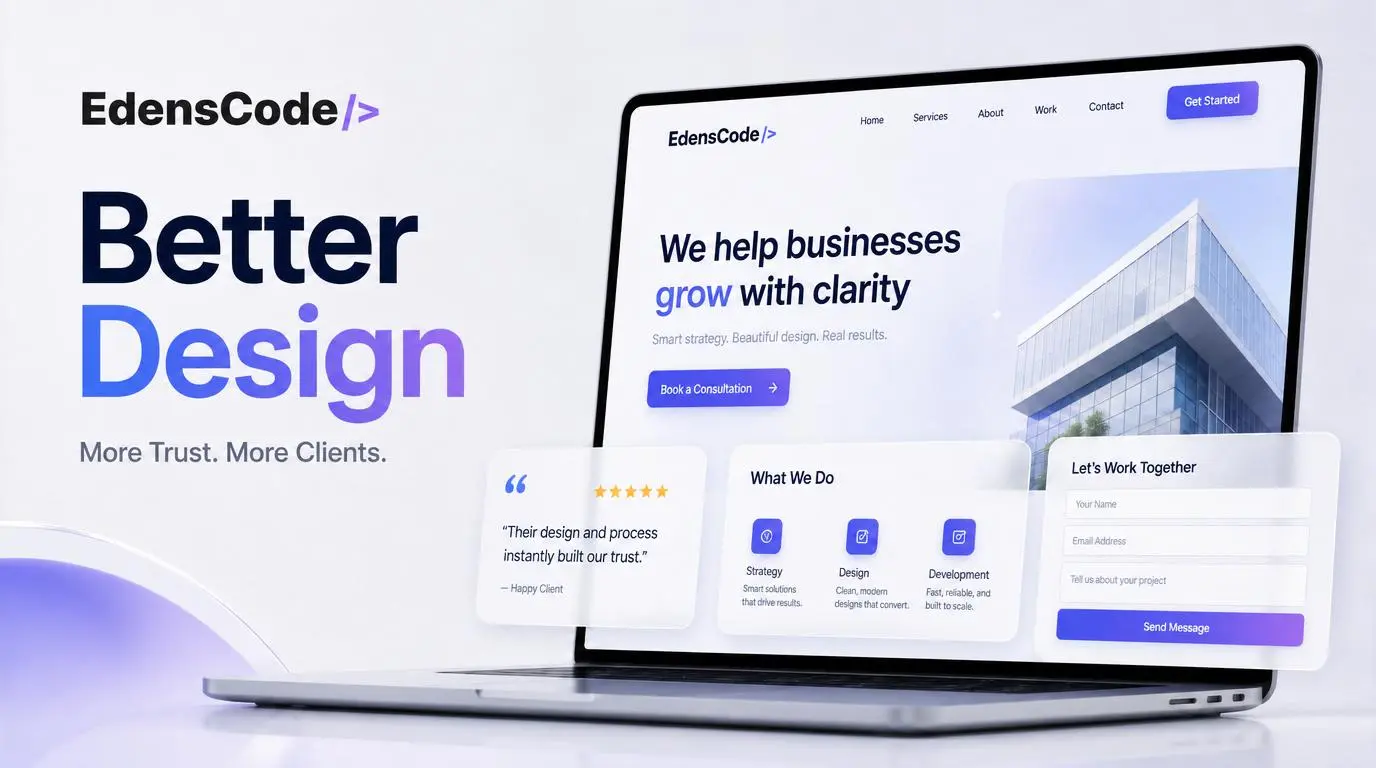
A lot of business owners think website design is mostly about how a website looks.
The colors.
The layout.
The images.
The animations.
The style.
Those things matter, but good website design is not only about making a business look nice.
Better website design helps people trust the business faster, understand the offer more clearly, and feel more confident taking the next step.
That matters because most clients do not contact a business the first time they see its name.
They compare.
They look at the website.
They check reviews.
They look at photos.
They read service pages.
They look at competitors.
They ask themselves if the business feels professional enough to trust.
Before someone calls, fills out a form, books a consultation, or requests a quote, they are already making a decision.
Your website is part of that decision.
A better website does not magically close every client by itself, but it can make the decision easier.
It can remove doubt.
It can create confidence.
It can make the business feel more established.
It can help the right people understand why they should choose you.
That is where better website design becomes more than appearance.
It becomes part of how your business sells.
That is why custom web design is not just about making a website look better. It is about helping the business feel clearer, stronger, and easier to trust online.
Quick answer: can website design help you close more clients?
Yes, better website design can help you close more clients because it improves the way people judge your business before they contact you.
A strong website can help with:
- clearer first impressions
- stronger trust
- better service explanations
- easier navigation
- better mobile experience
- stronger calls-to-action
- more confidence in the business
- less doubt before contacting you
Website design does not replace good service, good reviews, or real sales skills.
But it does support them.
If two businesses offer similar services, the one with the clearer, more professional, easier-to-trust website often feels like the safer choice.
That can make a real difference.
People judge your business before they contact you
Most people do not want to waste time.
When they search for a service, they usually compare a few options before reaching out.
They might open three websites.
They might check Google reviews.
They might look at photos.
They might scan the homepage.
They might read a service page.
They might compare pricing signals, quality, and professionalism.
This happens quickly.
People may not sit there and say, “This website has better spacing, better typography, and better conversion flow.”
But they feel it.
They notice when a website feels clean.
They notice when it feels outdated.
They notice when it loads slowly.
They notice when it feels confusing.
They notice when the business looks established.
They notice when the site feels generic or rushed.
That first feeling matters.
If the website creates trust, the visitor is more likely to keep reading.
If the website creates doubt, they may leave before ever giving the business a chance.
Better design builds trust faster
Trust is one of the biggest reasons website design matters.
A professional website makes a business feel more reliable.
Not because the design alone proves the business is good, but because it sends signals.
It shows the business cares about presentation.
It shows the business is active.
It shows the business invested in how customers experience them.
It makes the business feel more organized, more serious, and easier to trust.
That matters even more for service businesses.
If someone is hiring a contractor, med spa, law firm, repair shop, consultant, designer, or local service provider, they are not just buying a product.
They are trusting someone with their time, money, home, business, health, appearance, legal situation, or personal project.
The website needs to support that trust.
A weak website can make a strong business feel less professional than it really is.
A strong website can help the business feel closer to the quality of the work it already does.
Clear messaging makes the decision easier
Design is not only visual.
Good design also affects how information is organized.
A website should make it easy for visitors to understand:
- what you do
- who you help
- where you work
- why they should trust you
- what makes you different
- what step they should take next
If the website is vague, visitors have to work harder.
And most people will not work that hard.
They should not have to dig through paragraphs to understand the service.
They should not have to guess what area you serve.
They should not have to search for the contact button.
They should not have to figure out if the business is still active.
They should not have to wonder what happens after they reach out.
A better-designed website guides them.
It presents the most important information in the right order.
It makes the business easier to understand.
And when people understand faster, they decide faster.
Good design helps people feel like they are in the right place
One of the quiet jobs of a website is to make the right visitor feel like:
“This is probably for me.”
That feeling matters.
If someone lands on a website and the message feels clear, the design feels professional, and the service feels relevant, they are more likely to stay.
If the website feels generic, they may not feel any connection to the business.
A good website should reflect the type of customer the business wants to attract.
A premium service should not feel cheap online.
A trusted local business should not feel outdated.
A detail-focused company should not have a careless website.
A high-quality service should not look like it was thrown together.
The website should match the standard of the business.
When it does, it helps the right clients feel more confident choosing you.
Bad design creates doubt
Bad website design does not always look terrible.
Sometimes it just feels slightly off.
The spacing feels crowded.
The buttons are hard to find.
The phone number is hidden.
The copy sounds generic.
The images feel random.
The mobile version feels messy.
The service pages are thin.
The contact form feels basic.
The website loads slowly.
The design does not match the quality of the business.
Each issue might seem small on its own.
But together, they create doubt.
And doubt hurts conversion.
A visitor may think:
- Are they still in business?
- Do they actually do this service?
- Are they professional?
- Can I trust them?
- Is this a real company?
- Why does the website feel outdated?
- Should I keep looking?
That hesitation can cost leads.
Not because the business is bad, but because the website did not create enough confidence.
Better design can help justify higher prices
This is important.
If a business wants to charge professional prices, the website should support that level of trust.
People are more willing to pay more when a business feels more credible, organized, and professional.
That does not mean a website should pretend the business is something it is not.
It means the website should accurately reflect the quality of the business.
If the business does excellent work, has strong reviews, serves real customers, and takes pride in the service, the website should communicate that.
A weak website can make a strong business feel cheaper than it really is.
A better website can help the business feel aligned with the price it charges.
That can matter a lot when someone is comparing options.
The cheapest option does not always win.
The clearest, most trustworthy option often does.
Design helps turn traffic into opportunities
Traffic is not the same as leads.
A business can get visitors from Google, social media, referrals, ads, or word of mouth, but if the website does not build trust, those visitors may leave.
This is why website design and SEO should work together.
SEO can help more people find the website.
Design helps those people trust what they find.
A website that gets traffic but does not convert is leaving opportunity on the table.
A website that looks great but gets no traffic has a different problem.
The strongest foundation usually brings both together.
People need to find the business, but once they arrive, the website has to help them move forward.
That is where design becomes part of the sales process.
Calls-to-action should feel natural
A good website should make the next step clear.
That does not mean every section needs to scream “Buy now” or “Call today.”
Strong calls-to-action can be simple.
- Request a quote.
- Book a consultation.
- Call now.
- View services.
- Get started.
- Schedule a visit.
- Send a message.
The key is that visitors should not have to guess what to do next.
The website should guide them naturally.
A strong layout places calls-to-action where they make sense.
- After explaining the service.
- After building trust.
- After answering common questions.
- After showing proof.
- At the top for visitors who are ready.
- At the bottom for visitors who need more information first.
Good design makes taking action feel easy.
Mobile design matters because most people compare quickly
Many visitors will see the website on a phone first.
That means the mobile experience can make or break the first impression.
If the mobile site is hard to use, people may leave quickly.
Common mobile problems include:
- text that feels too small
- buttons that are hard to tap
- sections that feel too long
- images that load slowly
- menus that feel confusing
- forms that are frustrating
- important information buried too far down
- calls-to-action that are hard to find
A strong mobile design should feel simple.
The visitor should be able to understand the business, read the service information, see trust signals, and contact the business without friction.
If mobile feels smooth, the business feels easier to work with.
If mobile feels frustrating, the business may feel harder to trust.
A better website supports the sales conversation
A good website does not only help before someone contacts you.
It can also support the sales conversation after they reach out.
When a potential client has already seen a strong website, the conversation starts differently.
They already understand what you do.
They already saw the quality of your presentation.
They already read about your services.
They already saw signs of trust.
They already know how to take the next step.
That means the website can pre-sell the business before the first conversation.
It does not replace talking to the customer.
But it can make that conversation easier.
Instead of starting from zero, the business starts with more trust already built.
Better design makes referrals stronger
Referrals are powerful.
But even referred customers often check the website before reaching out.
Someone may hear about a business from a friend, but still search the name online.
If the website looks professional, the referral becomes stronger.
If the website feels outdated or unclear, it can weaken the referral.
That is why even businesses that depend mostly on word of mouth still need a strong website.
The website confirms the trust that the referral started.
It gives the potential client a place to learn more.
It makes the business easier to share.
And it helps the person feel more confident reaching out.
The website should answer quiet objections
People often have questions they do not say out loud.
- Can I trust this business?
- Do they work with people like me?
- Do they offer the service I need?
- Are they experienced?
- Are they professional?
- Will they respond?
- Do they care about quality?
- Are they worth the price?
A better website helps answer those questions before the visitor has to ask.
It can do that through:
- clear service pages
- reviews
- project examples
- photos
- FAQs
- strong messaging
- professional design
- easy contact options
- local signals
- a clear process
- helpful explanations
This is part of why design matters.
The design controls how those answers are presented.
If the information is buried, crowded, or unclear, it may not build trust.
If it is organized well, it helps the visitor feel more confident.
Good design does not need to be flashy
A website does not need to be loud to be effective.
It does not need heavy animations, trendy effects, or complicated layouts.
For many businesses, the best design is clean, clear, and intentional.
The goal is not to impress people with design tricks.
The goal is to make the business easier to understand and easier to trust.
A simple website can feel premium if it is well structured.
A minimal website can convert well if the message is clear.
A clean website can feel more professional than a busy one.
Good design should support the business, not distract from it.
The EdensCode perspective
At EdensCode, we see website design as more than decoration.
A website should help people understand the business, trust the business, and take the next step with confidence.
That means design, content, performance, SEO structure, and conversion all need to work together.
A website should look professional, but it should also be useful.
It should feel clear.
It should load fast.
It should work well on mobile.
It should explain the services.
It should guide people toward action.
It should reflect the quality of the business behind it.
Better website design helps close more clients because it reduces friction between interest and action.
It makes the business feel easier to choose.
And for businesses that care about how they are seen online, that matters.
Final answer: how does website design help you close more clients?
Better website design helps you close more clients by building trust before the sales conversation begins.
It helps people understand what you do.
It helps them compare you more confidently.
It supports your pricing.
It makes your business feel more professional.
It guides visitors toward the next step.
A website does not replace good service.
It does not replace reputation.
It does not replace real communication.
But it can support all of those things.
If your business already does quality work, your website should help people feel that quality before they ever contact you.
That is how better design helps turn visitors into real opportunities.
Frequently asked questions
Can website design help a business get more clients?
Yes. Better website design can help a business get more clients by building trust, making services easier to understand, improving the user experience, and guiding visitors toward the next step.
Does a better website close clients by itself?
No. A website does not replace good service, reputation, pricing, or real communication. But it can support the sales process by helping visitors feel more confident before they contact the business.
Why does website design affect trust?
Website design affects trust because people use the website to judge how professional, active, organized, and credible a business feels. A weak website can create doubt, while a strong one can build confidence faster.
Can bad website design cost a business leads?
Yes. If a website feels outdated, confusing, slow, generic, or hard to use, visitors may leave before contacting the business. Even small design problems can create doubt when people are comparing options.
Does website design matter if most clients come from referrals?
Yes. Many referred customers still check the website before reaching out. A strong website can confirm the trust created by the referral, while a weak website can make the potential client hesitate.
What makes website design good for closing clients?
Good website design should feel clear, professional, fast, mobile-friendly, easy to navigate, and focused on helping visitors understand the business and take action. It should answer questions, reduce doubt, and make the next step obvious.