
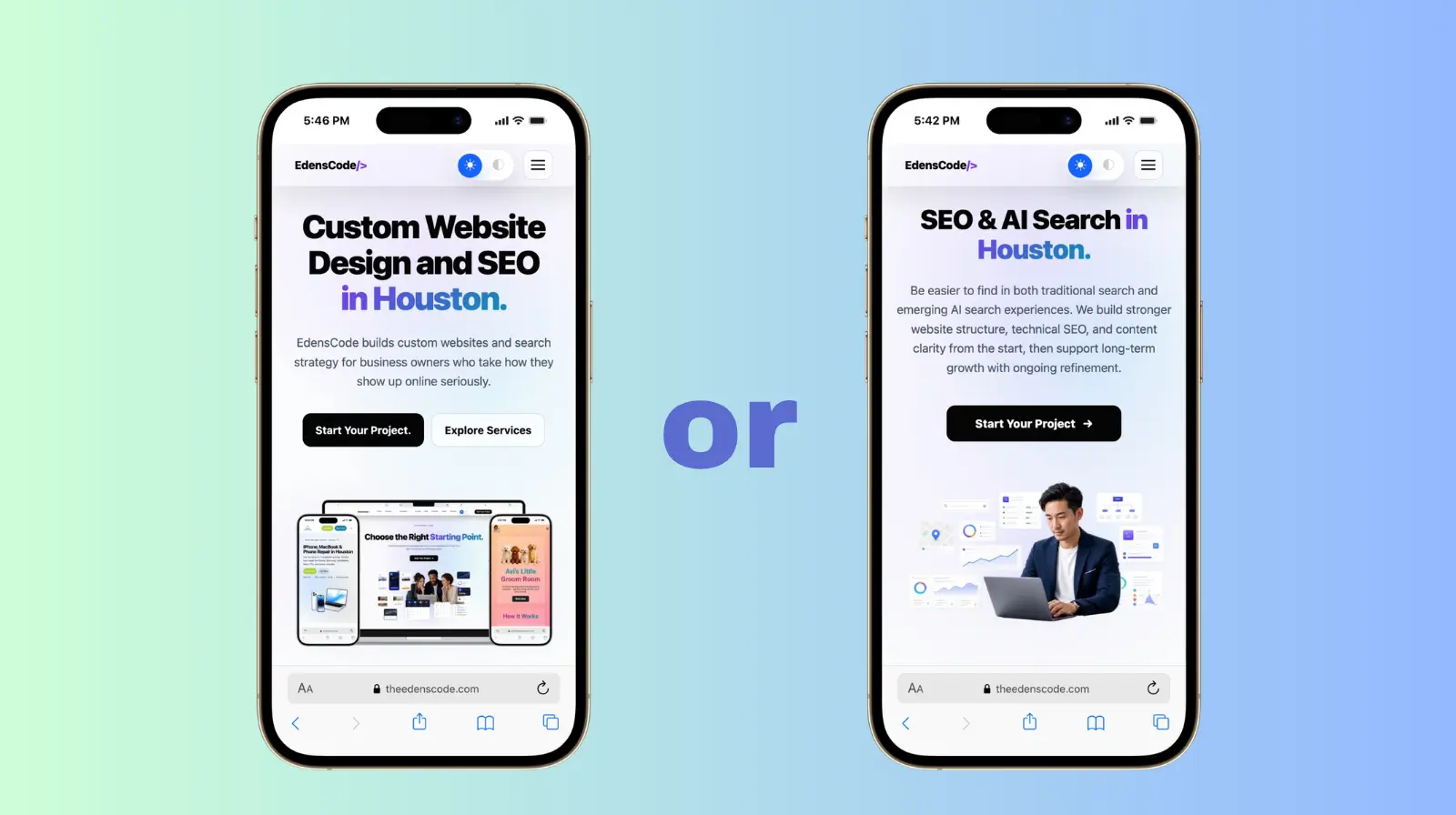
A lot of business owners eventually run into the same question:
Should I invest in a better website first, or should I invest in SEO?
It is a fair question.
A better website can help your business look more professional, build more trust, and turn more visitors into leads. SEO can help more people find your business through Google, local search, and other search experiences.
Both matter.
But they do not always matter in the same order.
If your website is outdated, slow, unclear, hard to use, or does not reflect the quality of your business, sending more traffic to it may not solve the real problem.
If your website already looks strong, explains your services clearly, loads fast, and has a good conversion flow, then SEO may be the next step to help more people find it.
The strongest long-term answer is usually not website or SEO. It is building a website where custom web design, SEO and search strategy, content, performance, and conversion all work together.
That is where many businesses get stuck.
They do not need just a prettier website.
They do not need random keywords added to a page.
They need a stronger online foundation.
Quick answer: website or SEO?
If your website is weak, fix the website first.
If your website is already strong but not getting enough visibility, SEO may come next.
If your goal is long-term organic growth, the website and SEO should be planned together.
A website without SEO may look good but never get found.
SEO without a strong website may bring traffic but fail to convert that traffic into leads.
The real goal is not choosing one forever.
The goal is knowing what your business needs first.
When the website should come first
Your website should usually come first if people are already visiting it, but they are not taking action.
That might mean they are not calling, filling out forms, booking consultations, requesting quotes, or staying long enough to understand your services.
A website should come first if:
- the design feels outdated
- the site loads slowly
- the content is vague
- the service pages are weak
- the mobile experience feels difficult
- the contact form feels generic
- the call-to-action is unclear
- the website does not reflect the quality of the business
- people compare you online before choosing who to contact
This matters because SEO can bring more attention to the website, but it cannot automatically fix the impression the website creates.
If the website feels confusing, cheap, or hard to trust, more traffic may only expose the problem to more people.
A stronger website helps create the foundation.
It gives visitors a clearer reason to trust the business, understand the offer, and take the next step.
When SEO should come first
SEO may come first when the website is already in good shape.
If your website looks professional, explains your services clearly, loads well on mobile, and already has a good contact or booking flow, then the bigger issue may be visibility.
In that case, SEO can help more of the right people find you.
SEO may come first if:
- the website already looks credible
- the main services are clearly explained
- the site is easy to use on mobile
- your contact flow already works
- you have proof, reviews, or project examples
- people trust the business once they land on the site
- the real issue is that not enough people are finding you
At that point, SEO can help build more search visibility around your services, location, questions customers ask, and the problems your business solves.
But SEO still needs a strong website to work well.
The content has to live somewhere.
The service pages need structure.
The site needs internal links, metadata, headings, schema, speed, and clear messaging.
SEO does not exist in a vacuum.
It depends on the website.
The problem with design-only websites
Some websites look beautiful but are not built to be found.
That does not mean they are useless.
A design-first website can work if the business already has another way to bring people to it.
For example, a beautiful website can work well when traffic comes from:
- referrals
- Instagram or TikTok
- Google Ads
- Facebook Ads
- email campaigns
- networking
- an existing customer base
- a strong offline reputation
In those cases, the website is mainly helping people trust the business after they already know about it.
That can be valuable.
The problem is when a business expects a design-only website to grow organically in search over time, but the website was never structured for that.
A beautiful homepage is not the same as an SEO foundation.
That is one reason we wrote about why SEO often struggles on template-built websites. The structure behind the design matters just as much as the way the page looks.
If the site has thin content, weak service pages, missing metadata, poor heading structure, no internal linking strategy, and unclear local signals, it may struggle to rank even if it looks great.
Design matters.
But design alone does not guarantee visibility.
The problem with SEO-only websites
The other side is also common.
Some websites are built mostly for SEO, but the user experience suffers.
The pages may technically target keywords, but the site feels cluttered, generic, or hard to read.
Instead of feeling like a real business, it starts to feel like a wall of text.
You may see:
- repeated keywords
- long blocks of copy
- generic stock images
- weak design
- crowded layouts
- basic forms
- poor mobile experience
- pages that feel written for search engines more than people
That kind of website might rank for certain searches.
But ranking is not the same as trust.
If someone lands on the page and the website feels outdated, overwhelming, or difficult to use, the business can still lose the lead.
SEO can bring the visitor.
Design and clarity help turn that visitor into a real opportunity.
Traffic is not the same as trust
Getting more visitors to a website is good.
But traffic alone does not mean the website is working.
A business can get clicks and still lose leads if the website does not build confidence.
People make quick decisions online.
They look at the design, the wording, the reviews, the service details, the photos, the speed, and the overall feeling of the website.
They may not consciously think about every detail, but they feel the difference.
A strong website helps answer quiet questions in the visitor’s mind:
- Is this business legitimate?
- Do they offer what I need?
- Do they seem professional?
- Can I trust them?
- Are they better than the other options?
- What should I do next?
If the website does not answer those questions clearly, more traffic may not create better results.
That is why SEO and website design should not be treated as completely separate things.
One brings attention.
The other helps shape what that attention becomes.
Ranking is not the same as conversion
Ranking on Google can be valuable.
But ranking alone is not the finish line.
The real business goal is not just traffic.
The goal is calls, form submissions, bookings, quote requests, consultations, or whatever action matters most for the business.
That means the website has to convert.
A conversion-focused website does not have to be aggressive or pushy.
It just needs to make the next step clear.
That can mean:
- a clear headline
- strong service sections
- easy-to-find contact buttons
- a clean form
- trust signals
- reviews
- project examples
- location information
- helpful FAQs
- simple navigation
- fast mobile experience
A website that ranks but does not convert is leaving opportunity on the table.
A website that looks beautiful but does not get found is also leaving opportunity on the table.
The best websites are built to do both.
Why website design and SEO should work together
Website design and SEO are often treated like separate services.
But on a serious business website, they affect each other constantly.
SEO needs clear pages, useful content, structure, metadata, internal links, and technical quality.
Design needs clear messaging, visual hierarchy, spacing, trust, speed, and a smooth user experience.
Copywriting connects both.
Performance affects both.
Conversion strategy depends on both.
A strong website needs all of these pieces working together.
For example, a service page should not just exist because SEO needs a keyword target.
It should also help a real person understand the service, see why the business is credible, and know how to take the next step.
A homepage should not just look impressive.
It should quickly explain what the business does, who it helps, why it can be trusted, and where the visitor should go next.
SEO brings structure.
Design brings trust.
Copy brings clarity.
Performance creates confidence.
Conversion turns attention into action.
That is the system.
Where AI search fits into this
AI search is another reason website design and SEO should not be treated like separate things.
People are not only searching through traditional blue links anymore. They may see AI Overviews, AI-assisted summaries, local results, map listings, and search experiences that try to answer questions faster.
That does not mean businesses should panic or chase every new AI trend.
It means the website needs to be easier to understand.
Clear service pages, helpful explanations, strong local signals, clean structure, schema when appropriate, and trustworthy content all matter because search engines and AI-assisted search systems need to understand what the business does.
A vague website makes that harder.
A thin website makes that harder.
A beautiful website with very little explanation can also make that harder.
The goal is not to “trick” AI search.
The goal is to make the business clear enough that both people and search systems can understand it.
That is why strong website structure, SEO, and content quality still matter.
AI search does not remove the need for a good website.
The same idea applies to AI-generated websites. AI can help create pages faster, but it does not automatically create the strategy, structure, or judgment needed for long-term growth. We explain that more in Can an AI Website Rank on Google?.
It raises the standard for clarity.
What a balanced website should include
A balanced website should not feel like it was built only for search engines or only for appearance.
It should feel clear, useful, fast, and trustworthy.
A strong small business website should usually include:
- a clear homepage
- service pages with real explanations
- local signals when location matters
- strong calls-to-action
- contact forms that feel intentional
- phone number and contact options
- reviews or testimonials
- project examples or proof
- fast mobile performance
- clean heading structure
- metadata
- internal links
- schema markup when appropriate
- helpful FAQs
- analytics or conversion tracking
- room to grow over time
If you are also comparing budget levels, our guide on how much a website costs in Houston breaks down what usually changes between a $250, $500, and $3,000+ website.
This is where the difference between “having a website” and having a real business foundation becomes clear.
A basic website may exist online.
A stronger website helps the business show up, explain itself, earn trust, and create opportunities.
Why this is hard for many agencies
A lot of agencies lean heavily in one direction.
Some are very design-focused.
They can make a beautiful website, but they may not think deeply about search structure, service pages, metadata, schema, local SEO, or how the website can grow organically over time.
Others are very SEO-focused.
They may understand keywords, rankings, and content volume, but the website experience may feel generic, crowded, or disconnected from the quality of the business.
Both approaches can work in the right situation.
A design-first website can work if the business has paid traffic, social media traffic, or strong referrals.
An SEO-first website can work if visibility is the only goal and the market is mostly search-driven.
But many businesses need more than one side.
They need a website that can be found and trusted.
They need a site that looks professional and has structure.
They need pages that are useful for people and understandable for search engines.
That combination is harder to find.
It usually requires design taste, technical skill, SEO thinking, copy clarity, and business strategy to work together.
The studio approach
This is where a studio approach can make more sense than a traditional one-size-fits-all agency model.
A studio can focus more deeply on the full website experience.
Not just the design.
Not just the SEO.
Not just the code.
The full system.
That means thinking about how the website looks, how it loads, how it reads, how it ranks, how it builds trust, and how it guides people toward action.
Of course, not every studio does all of this.
Some studios are mainly design studios.
Some are mainly development studios.
Some are mainly branding studios.
But when a studio understands both website design and SEO structure, the result can feel much more complete.
That is the kind of website many local businesses actually need.
Not a template with keywords added later.
Not a beautiful homepage with no search foundation.
A website built with both sides in mind from the start.
The EdensCode perspective
At EdensCode, we see website design and SEO as parts of the same system.
A website should not force a business to choose between looking professional and being easier to find.
It should do both.
That does not mean every business needs a huge website or an aggressive SEO campaign right away.
Some businesses need a simple foundation.
Some need a better website before SEO makes sense.
Some already have a good website and need more visibility.
Some need a full search and conversion system.
The right answer depends on the stage of the business, the quality of the current website, the competition in the market, and how much the business depends on online leads.
But the standard should stay the same:
A website should reflect the quality of the business behind it.
That idea is also why we wrote Does Your Website Reflect the Quality of Your Business in 2026?. A website should not make a strong business look weaker than it really is.
It should be clear.
It should be fast.
It should be structured well.
It should help people trust the business.
And if organic growth or AI-assisted search visibility matters, SEO should be part of the foundation from the beginning.
So which one do you need first?
If your website is outdated, unclear, slow, or hard to trust, start with the website.
If your website is already strong but not enough people are finding it, start with SEO.
If you are building a new website and want long-term organic growth, plan both together from the start.
That is usually the best path.
Because a website and SEO are not really separate when the goal is growth.
The website is where trust is built.
SEO is how more people find it.
And when both work together, the business has a much stronger foundation online.
Frequently asked questions
Should I build a website or do SEO first?
If your current website is outdated, unclear, slow, or not converting visitors, it usually makes sense to improve the website first. If the website is already strong but not getting enough traffic, SEO may be the better next step.
Can SEO work without a good website?
SEO can bring traffic to a website, but a weak website may struggle to convert that traffic into leads. If the design, content, speed, or contact flow creates friction, the business can still lose opportunities.
Can a beautiful website rank on Google?
Yes, but only if it also has the right structure, content, metadata, technical foundation, and SEO signals. A beautiful website with thin content or weak structure may struggle to rank organically.
Is website design more important than SEO?
Website design and SEO serve different purposes. Design helps build trust and improve the user experience. SEO helps people find the website. For most businesses, the strongest result comes when both work together.
Does AI search change whether I need SEO?
AI search does not remove the need for SEO. It makes clear structure, helpful content, technical quality, local signals, and trust even more important. A website still needs to be easy for both people and search systems to understand.
Why do some SEO websites look bad?
Some SEO-focused websites prioritize keywords, content volume, and rankings over design, usability, and conversion. That can lead to cluttered pages, repeated keywords, generic layouts, and forms that do not feel intentional.
What should a business website include for both SEO and conversions?
A strong business website should usually include clear service pages, helpful content, strong calls-to-action, reviews or proof, local signals, fast performance, clean headings, metadata, internal links, schema when appropriate, and an easy contact flow.
Does EdensCode build websites with SEO included?
EdensCode builds websites with search structure, performance, clarity, and trust in mind from the start. The goal is to create a website foundation that looks professional, supports SEO, and helps visitors take action.