
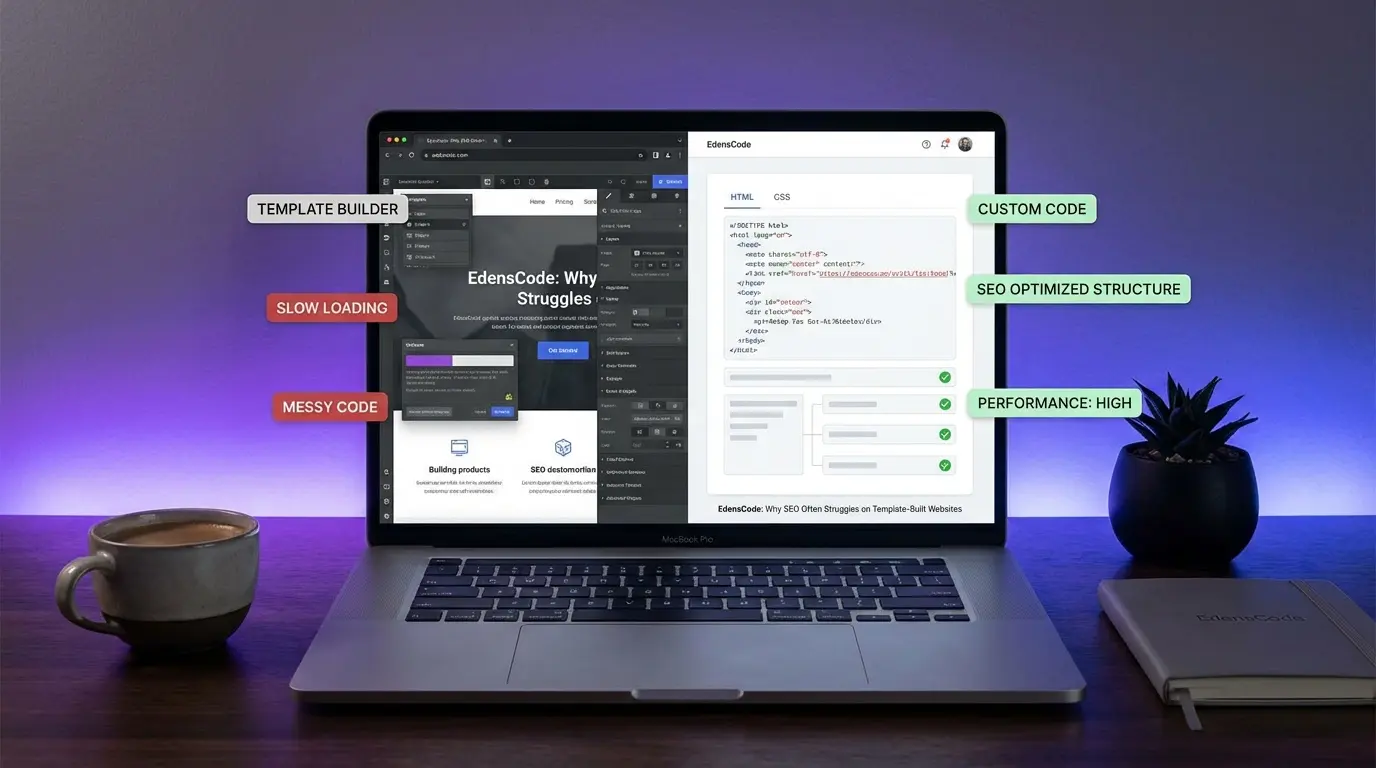
A lot of business owners think SEO is something you add later with a plugin, a few keywords, and a page title update.
That is one of the biggest reasons SEO underperforms on template-built websites.
On many platforms, SEO is handled through themes, page builders, and plugins like Yoast SEO or Rank Math. Those tools can be helpful, but they are still layered on top of a system that was not always built cleanly from the start.
When too many tools are involved, problems start to show up. Metadata can be duplicated, headings can be structured poorly, pages can become bloated, and search engines may end up reading a site that feels less clear than the business owner expects.
That does not mean every template website is bad. It means many of them rely on too many moving parts, and that creates more room for SEO issues that are easy to miss.
A custom-coded website gives more control over how the site is structured, how the metadata is written, how the schema is handled, and how the pages are delivered to both users and search engines. That is one of the biggest advantages of Custom Web Design.
That matters because SEO works better when it is built into the foundation of the website instead of added on later.
Speed is another big part of this. A slower website does not just hurt rankings. It also changes how people experience the business. If a site feels clunky, delayed, or heavy, that affects trust before anyone ever reads the content.
And you do not need to understand SEO or code to notice that. People can feel when a website is slow, confusing, or harder to use than it should be. Your visitors notice it right away.
Google notices it too. Cleaner structure, faster performance, better page organization, and clearer metadata all help search engines understand the site more effectively.
That is why SEO should not be treated like a plugin decision. It should be treated like a build decision.
If the website is built properly from the start, SEO has a much stronger foundation to work from. And if your current site already feels limited, slow, or hard to grow, that is often a sign it may be time to think about Website Migrations.
A better website does not guarantee rankings overnight. But it does remove many of the problems that quietly hold SEO back.
That is the difference between adding SEO to a website and building a website that is ready for SEO from the start. It is also why posts like Next.js vs WordPress for Business Websites in 2026 matter more than they used to.